Behringer Neutron Synth Patches: How A 56-Point Patchbay Aids Sonic Exploration
Key Takeaways
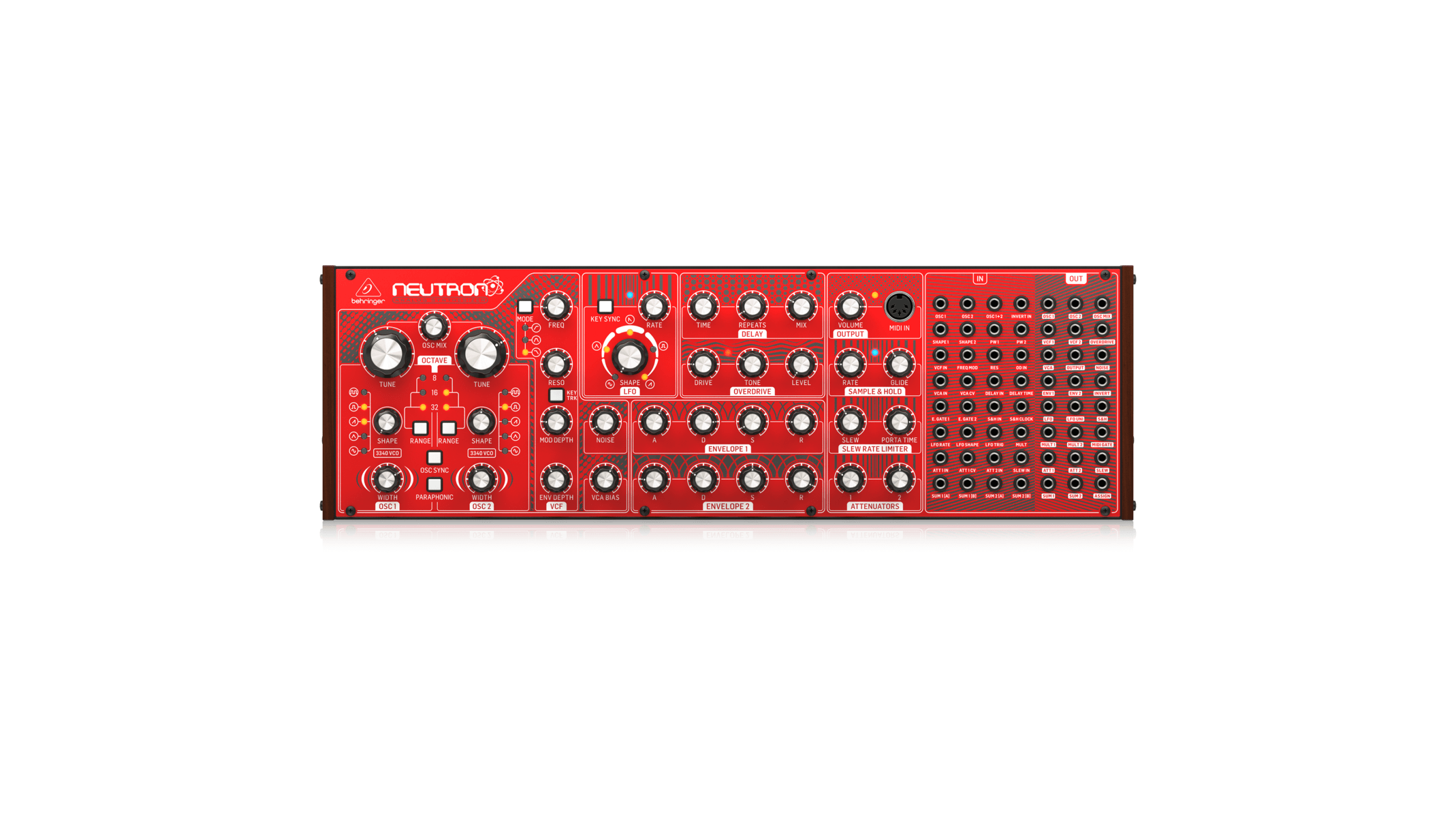
- The 56-point patchbay on the Behringer Neutron breaks free from normalized signal paths, enabling signal routing usually reserved for high-end modular systems.
- A semi-modular design provides an accessible entry point into synthesis architecture and manual signal routing.
- Advanced techniques like Frequency Modulation (FM) and Amplitude Modulation (AM) transform standard VCOs into complex sound generators.
- Onboard utility modules—including attenuators and slew rate limiters—provide the precision control required for professional studio work.
56 Patch Points That Break Every Rule
The Neutron's patchbay reflects Behringer's bold design philosophy. Unlike fixed-architecture instruments that route signals through predetermined paths, this semi-modular approach exposes nearly every internal connection point. With 32 inputs and 24 outputs, each patch point is an opportunity to bypass or completely reimagine the signal flow.
This level of access typically requires investing in premium modular systems. The Behringer Neutron provides this flexibility in a self-contained, affordable package. The mini-jack format follows Eurorack standards, ensuring compatibility with external hardware while maintaining a compact desktop form factor. Modern synthesizer design in this category prioritizes user creativity over rigid manufacturer assumptions about signal flow.
Breaking Free From Fixed Signal Paths
Bypassing Default Architecture
Standard synthesizers route signals linearly: oscillators feed filters, which feed amplifiers. The Neutron's patchbay reveals these hidden connections, allowing the interruption or redirection of the default architecture. For example, routing the filter output back into an oscillator for feedback synthesis is achieved by patching the filter output directly to the oscillator's FM input.
Unique Modulation Routings
The default normalization routes the LFO to filter cutoff and pulse width modulation. Through the patchbay, this single LFO can simultaneously modulate oscillator pitch, filter resonance, delay time, and overdrive amount. Utilizing the dual attenuators allows for precise control over modulation depth, creating evolving textures from simple source signals.
Non-Linear Sound Design
Linear signal processing follows predictable paths, but the Neutron enables recursive experimentation. Sample and hold circuits can trigger envelope generators, which then control LFO rates. These modulation chains create organic, unpredictable textures that mimic natural acoustic phenomena—a hallmark of high-end sound design.
Beyond Internal Capabilities
External CV Integration
The patchbay accepts external control voltage (CV) signals, expanding the Neutron's capabilities beyond its internal modules. External step sequencers can control multiple parameters simultaneously, and external LFOs can provide modulation sources with characteristics different from the onboard oscillators. Envelope followers can analyze external audio sources to control synthesizer parameters.
Eurorack System Expansion
For those building modular rigs, the Neutron integrates seamlessly with Eurorack modules. The main module can be removed from its chassis and mounted in a standard 80HP Eurorack case. Its oscillators can serve as sound sources for external filters, while its own filter section can process modular signals, making it an ideal bridge between conventional and modular synthesis.
Essential Utility Modules for Advanced Control
Attenuators for Signal Shaping
The Neutron includes two dedicated attenuators essential for complex patching. These modules reduce signal strength and provide fine control over modulation depth. Without attenuators, LFO modulation often produces excessive pitch instability. Attenuators allow for the subtle, premium-quality vibrato found on professional recordings.
Slew Rate Limiters for Smooth Transitions
Sharp voltage transitions can create audible clicks in a signal. The slew rate limiters smooth these transitions, converting stepped voltages into curved glides. This is particularly valuable when using Sample & Hold sections or digital sequencers that output abrupt voltage changes.
Sample & Hold for Random Modulation
The dedicated sample and hold section captures voltage levels at timed intervals to create stepped modulation. When the sample rate matches musical tempos, it creates rhythmic parameter changes. Random sampling rates produce organic, evolving modulation that avoids mechanical repetition.
FM, AM, and Audio-Rate Experimentation
Frequency Modulation (FM)
The patchbay enables sophisticated FM synthesis by routing one oscillator's output to another's frequency input. Because the V3340 VCOs—recreations of the legendary CEM3340 chips—are highly stable, users can achieve clear, bell-like tones or aggressive, metallic textures. Unlike traditional FM synths using internal menus, the Neutron allows for real-time adjustment of carrier-to-modulator ratios.
Amplitude Modulation (AM)
Amplitude modulation effects can be achieved by creatively patching oscillator outputs through an attenuator's input while another oscillator feeds its CV input. While not a dedicated ring modulator, this technique generates inharmonic, metallic timbres.
Complex Drone Creation
Drone synthesis benefits from the instrument's patching flexibility. Multiple oscillators can run at slightly different frequencies to create slow beating effects. The analog delay section, based on Bucket Brigade (BBD) technology, adds spatial dimension. With delay times from 25 to 640ms, infinite sustain effects are possible by modulating delay time while feedback approaches self-oscillation.
Community-Driven Patch Innovation
Online synthesizer communities actively share Neutron patch ideas, creating a knowledge base that extends beyond the manual. User-generated techniques often uncover applications like polyrhythmic sequencing or chaotic feedback synthesis that were not initially documented. These shared techniques accelerate the learning curve for new producers.
Case studies documented by users help others understand not just what to patch, but the underlying theory of why certain connections produce desired results. This iterative process builds a deeper understanding of synthesis principles.
A Beginner's Gateway To Modular Synthesis
The Behringer Neutron's value extends into education. Learning to patch connections manually builds an intuitive understanding of signal flow and modulation that applies to every instrument in a studio. The physical patching process reinforces learning in ways that software interfaces cannot match.
The budget-friendly price point removes traditional barriers to modular experimentation. For musicians ready to move beyond conventional boundaries, consulting synth experts who understand synth setup and its use in a studio provides a professional foundation for complex sound design.
*Note: Pricing and/or product availability mentioned in this post are subject to change. Please check theSam Ashwebsite for current pricing and stock information before making a purchase.
Sam Ash
City: Hicksville
Address: 278 Duffy Ave
Website: https://www.samash.com/


Comments
Post a Comment