When Capability Outpaces Understanding, Risk Becomes Invisible
Across technology-driven organizations, a subtle pattern has begun to repeat. Systems scale. Tools accelerate. Output increases. Execution continues. Yet despite visible progress, decisions feel heavier, confidence fragments and momentum becomes fragile.
This is not a contradiction. It is a signal.
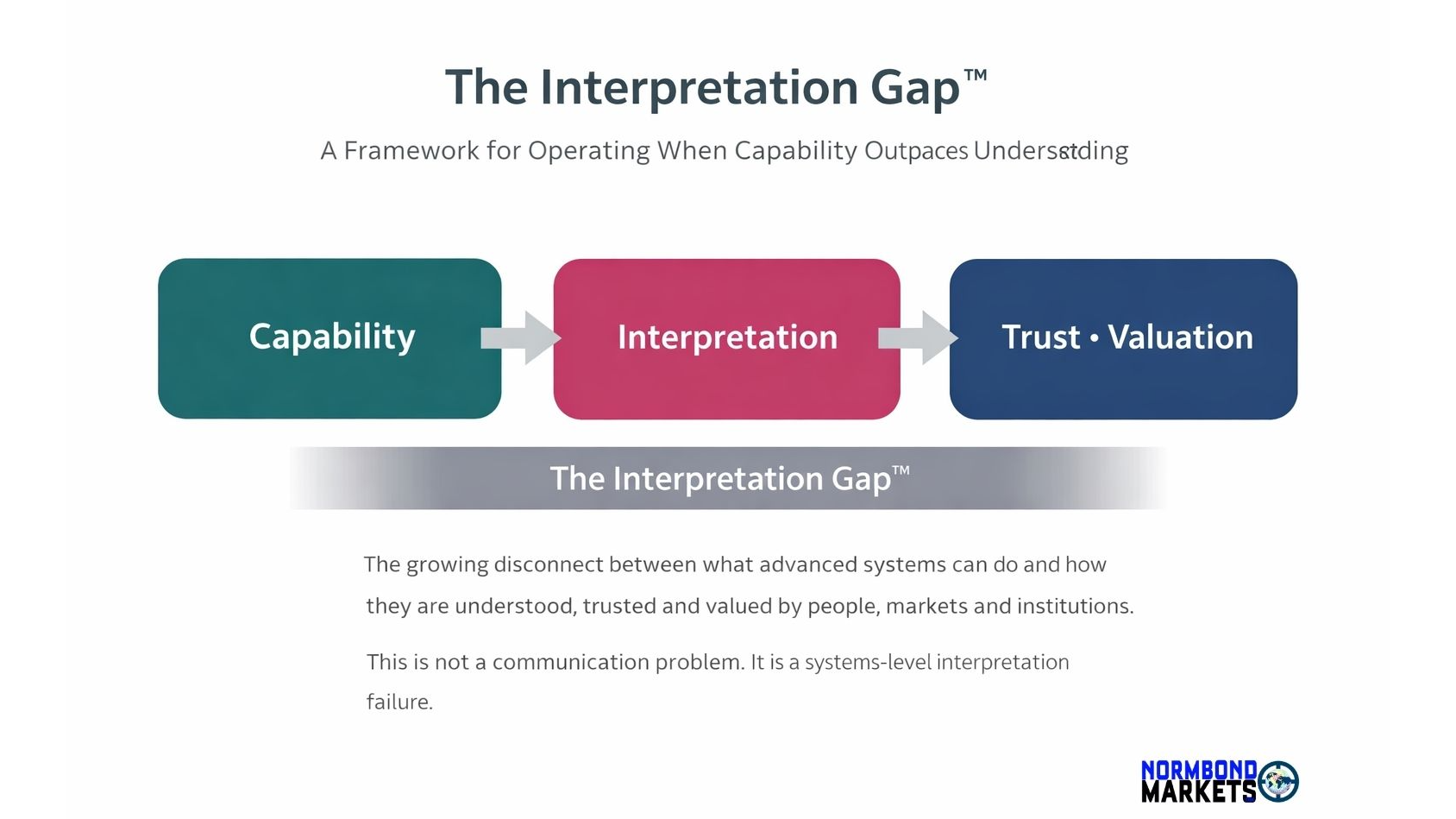
The growing challenge facing advanced organizations is not an absence of capability, but an absence of shared understanding. As AI and complex systems mature, they increasingly outpace the frameworks used to interpret them. This widening disconnect is known as The Interpretation Gap.
The Interpretation Gap describes the space between what systems can do and how those systems are understood, trusted, and valued by people, markets, and institutions. When that gap widens, risk does not announce itself through failure. It compounds quietly through misclassification.
Why Failure No Longer Looks Like Failure
Most organizations do not fail because nothing works. Increasingly, failure emerges when something can no longer be interpreted safely.
In these environments, execution often continues uninterrupted. Dashboards remain green. Roadmaps stay intact. Teams keep shipping. The danger lies not in breakdown, but in drift.
Signals begin to conflict. Confidence becomes harder to articulate. Decisions rely more heavily on intuition or precedent than on shared meaning. Over time, leaders sense that momentum is fragile but struggle to explain why.
This is not an execution problem. It is an interpretation failure upstream.
Markets Price Confidence, Not Capability
Markets do not price potential. They price confidence.
Confidence forms when behavior is predictable, intent is legible, risk feels governed, and meaning remains stable. These conditions depend less on raw technical capability and more on interpretation.
When interpretation lags behind capability, several patterns emerge:
- Trust erodes despite improving performance
- Adoption slows even as products mature
- Valuation compresses without obvious cause
- Decision cycles lengthen while uncertainty increases
Strong systems do not fail first. Understanding does.
The Cost of Misclassification
One of the most expensive errors organizations make is misclassifying the type of problem they are facing.
Many assume stalled momentum signals an execution constraint. Resources are added. Velocity increases. Visibility expands. Yet uncertainty persists.
Accelerating the wrong thing does not resolve ambiguity. It amplifies it.
Misclassification often occurs precisely because systems appear to be working. Capability compounds faster than shared understanding. Teams continue operating inside a decision frame that no longer fits the system they are scaling.
This is why the most costly mistakes are rarely execution failures. They are problem-classification failures.
The Interpretation Gap Diagnostic
The Interpretation Gap Diagnostic exists to resolve this distinction before further decisions are made.
The diagnostic is a short, structured intervention designed to determine whether uncertainty is being caused by an execution limitation or by an interpretation failure upstream. It serves as the correct entry point for environments where getting the next decision wrong would be expensive or irreversible.
Classification precedes momentum.
Only after interpretation has been stabilized does it become possible to determine whether execution, strategy, or visibility should follow.
Execution Is a Consequence of Clarity
In environments shaped by advanced technology, execution cannot substitute for clarity.
Visibility does not repair interpretation failures. Growth does not resolve misaligned meaning. Acceleration without understanding compounds risk.
For this reason, The Interpretation Gap operates upstream of strategy, growth, and execution. Strategic advisory follows only when judgment must be held across multiple decisions under sustained ambiguity. Visibility and narrative systems are introduced only if execution is confirmed as the true constraint.
In this model, execution becomes a consequence of clarity rather than a response to pressure.
Trust Architecture, Not Storytelling
Closing the Interpretation Gap requires designing understanding, not merely explaining systems after the fact.
This process includes clarifying leadership intent, translating complex systems into stable mental models, aligning narrative with actual system behavior, and making trust legible where decisions are made. This discipline is referred to as Trust Architecture.
Trust Architecture defines where judgment lives, who is accountable under ambiguity, and how decisions are explained when outcomes remain uncertain. When interpretation is designed early, scale compounds cleanly. When interpretation is deferred, markets design meaning externally, often in ways that increase perceived risk.
Where the Interpretation Gap Appears
The Interpretation Gap is visible across multiple domains:
- Inside organizations, advanced tools are deployed while workflows remain unchanged, leading to shadow systems and declining trust.
- In markets, products improve while narratives fragment, causing buyers and investors to hesitate despite technical progress.
- In governance and law, certainty fades and interpretation becomes the control layer as guardrails replace guarantees.
In each case, capability advances. Confidence lags.
A Different Starting Point
The Interpretation Gap is not a communication problem. It is a systems-level interpretation failure.
Organizations facing high-stakes decisions in AI and emerging technology environments benefit from beginning with classification rather than momentum. Understanding the problem frame is what allows execution to compound rather than destabilize.
Additional context, framework material, and diagnostic information is available at https://normbondmarkets.com/
NormBondMarkets
City: Philadelphia
Address: Philadelphia USA
Website: https://normbondmarkets.com
Email: norm@normbond.com


Comments
Post a Comment