Is The Theory Of Gravity Wrong? New Research Could Change Everything
Why Scientists Are Rethinking the Origins of Mass and Gravity
In 2025, physicists revisited one of the most fundamental questions in science: where mass actually comes from. New theoretical work exploring higher-dimensional space suggests that mass and gravity may not be intrinsic properties of matter at all, but emergent effects shaped by dimensions beyond those humans can directly observe. As reported in mainstream science coverage, these ideas build on decades of mathematical research while offering new frameworks for understanding how the universe is structured.
But does this mean that Einstein got it wrong?
The Challenge of Interpreting Breakthrough Physics
While such discoveries capture headlines, they often remain difficult to interpret outside academic circles. Concepts like extra dimensions, quantum fields, and particle interactions are frequently discussed using advanced mathematics, creating a gap between cutting-edge research and public understanding. This gap can leave many people aware that “something important” is happening in physics without a clear sense of why it matters.
The difficulty is compounded by the abstract nature of the subject matter. Unlike advances in medicine or technology, theoretical physics does not always produce immediate, visible applications. Its value lies in refining how reality itself is understood, which can (ironically) feel remote from everyday experience.
Why Higher-Dimensional Theories Matter
Despite their complexity, higher-dimensional models address long-standing inconsistencies in physics. Traditional frameworks struggle to reconcile gravity with quantum mechanics, the theory governing subatomic particles. By proposing that familiar forces may arise from interactions across unseen dimensions, researchers aim to unify these competing models into a more coherent explanation of nature.
This line of inquiry is not speculative in the casual sense. It relies on rigorous mathematical formulations tested against existing experimental data. Facilities such as particle accelerators play a crucial role by probing conditions where subtle effects predicted by these theories might become measurable.
What This Means for Einstein’s Theory of Relativity
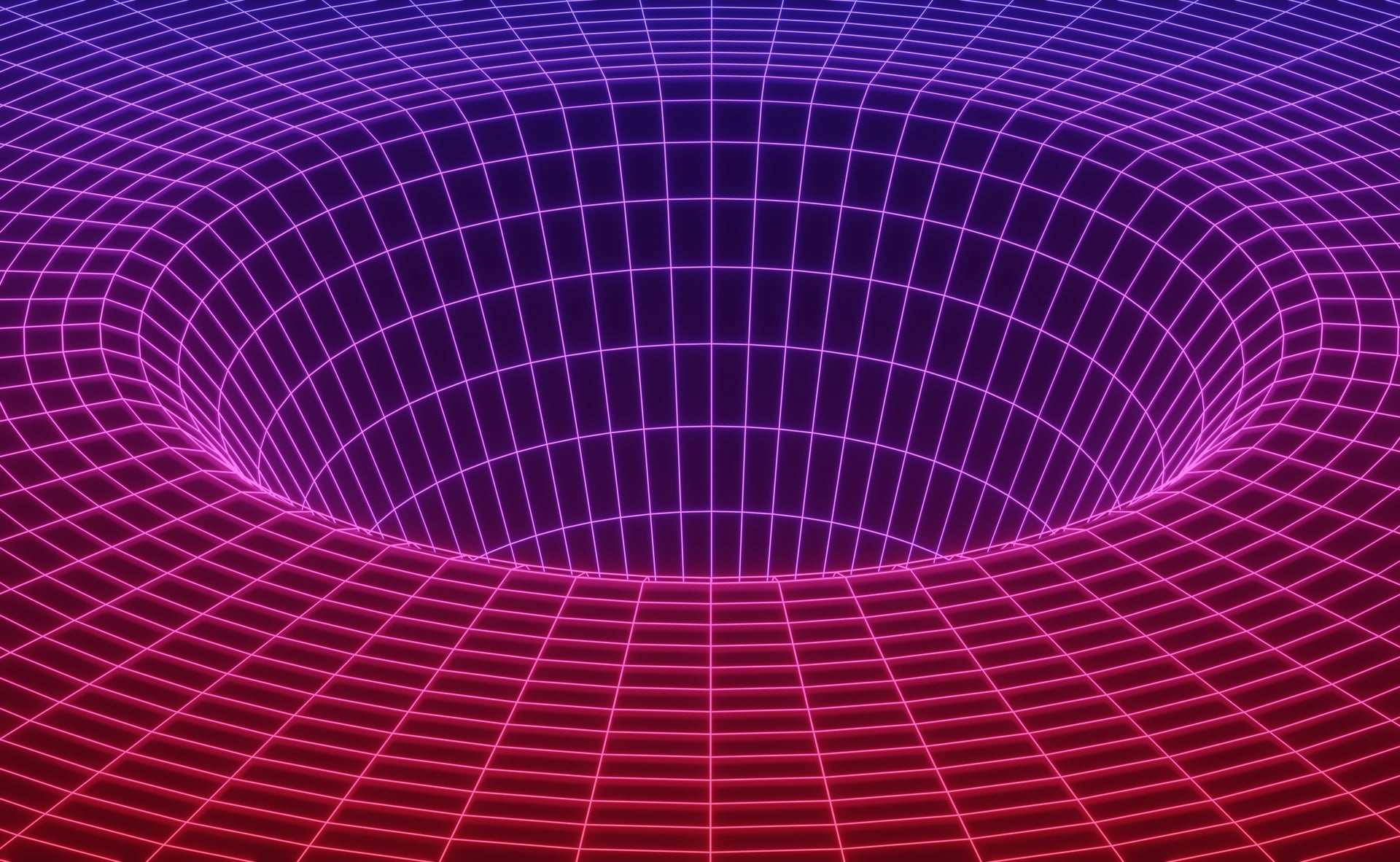
Einstein’s theory of general relativity has defined scientific understanding of gravity for more than a century, describing it as the curvature of spacetime caused by mass and energy. While extraordinarily successful at explaining large-scale phenomena, such as planetary motion and black holes, general relativity remains difficult to reconcile with quantum mechanics.
Higher-dimensional research offers one possible bridge between these frameworks. By suggesting that gravity and mass may emerge from geometric effects in additional dimensions, scientists are exploring extensions rather than replacements of Einstein’s work. In these models, relativity continues to describe how gravity behaves in observable space, while deeper dimensional structures may explain why gravity exists in its familiar form at all.
Such approaches could eventually help clarify why gravity is weaker than other fundamental forces or why mass behaves differently at quantum scales. Importantly, these ideas aim to preserve the predictive accuracy of relativity while addressing questions it was never designed to answer.
Making Complex Science Accessible
As scientific research becomes more specialized, the need for clear interpretation grows. Translating advanced ideas into accessible language does not mean oversimplifying them; it means providing context. Explaining how theories are developed, debated, and refined helps non-specialists appreciate both the promise and the limitations of new research.
Educational initiatives increasingly emphasize process over conclusions. Understanding how scientists think—how hypotheses evolve, how uncertainty is managed, and how evidence is weighed—offers valuable insight into the nature of knowledge itself.
The Human Dimension of Scientific Inquiry
At its core, physics remains a human endeavor driven by curiosity and persistence. Researchers spend decades refining equations, questioning assumptions, and confronting uncertainty. Recognizing this human element makes abstract theories more relatable and underscores why progress often unfolds gradually rather than through sudden breakthroughs.
As interest in foundational questions about reality grows, its broader implications will likely shape how future generations understand space, time, and gravity. Staying informed through credible, well-contextualized resources offers a way to engage with these ideas thoughtfully, without requiring specialized training.
Sam Toney
City: Thonotosassa
Address: 10072 Main Street
Website: https://revelationequation.com


Comments
Post a Comment