How To Tow An RV Safely? The Checks, Equipment & Skills Every Driver Needs
Key Takeaways:
- Safe RV towing requires understanding vehicle towing limits, maintaining proper tongue weight (10-15% for conventional hitches, 15-30% for fifth wheels), and conducting thorough pre-trip inspections
- Extended side mirrors and sway control systems are vital safety equipment that prevent accidents and eliminate dangerous blind spots
- Practicing maneuvers in empty parking lots and mastering emergency sway response techniques builds confidence before hitting the highway
- Professional hitch installation provides proper weight distribution and eliminates costly towing mistakes that could damage your vehicle or RV
Towing an RV transforms an ordinary vehicle into a completely different driving experience. The extra length, weight, and dynamics create challenges that catch many first-time towers off guard, leading to white-knuckle moments on highways and embarrassing situations at campgrounds. Understanding the fundamentals of safe towing prevents these scenarios and builds the confidence needed for enjoyable adventures.
Know Your Vehicle's Towing Limits First
Every vehicle has a maximum towing capacity that can be found on the driver's side door frame sticker, in the owner's manual, or by contacting the manufacturer. This number represents the absolute limit under ideal conditions, but smart towers stay well below this threshold. Exceeding towing capacity strains the engine, transmission, and braking system, potentially causing expensive damage or dangerous situations on steep grades.
The gross vehicle weight rating (GVWR) includes everything: the RV's dry weight, fresh water, propane, gear, food, and passengers. A typical travel trailer's dry weight increases by 1,500-2,000 pounds when fully loaded for camping. Calculate the total weight before departure, not after loading everything at the campsite.
Payload capacity matters just as much as towing capacity, says R&B Hitch of Ocala. The tongue weight from the hitch, passengers, and cargo in the tow vehicle all count against the payload limit. Professional installation services can provide proper weight distribution calculations during the setup process - and peace of mind.
Pre-Trip Safety Checks
A thorough pre-trip inspection prevents roadside emergencies and dangerous equipment failures. These checks take 15-20 minutes but save hours of potential trouble and keep families safe throughout the trip. Here's the safety checks that R&B Hitch say you can't afford to miss:
1. Check Tire Pressure and Inspect for Damage
RV tires carry significantly more weight than standard vehicle tires and require higher air pressure. Check the tire's sidewall and the vehicle's load information sticker for the recommended PSI, as the correct pressure depends on the specific tire and load. Check pressure when tires are cold, before driving, as heat from road friction increases pressure readings by 10-15 PSI.
Inspect sidewalls for cracks, bulges, or embedded objects like nails or screws. Tread depth should exceed 4/32 of an inch for safe highway travel. Replace tires showing signs of uneven wear, which indicates alignment problems or improper loading. Don't forget the spare tire - it needs proper pressure and condition checks too.
2. Verify Hitch Connection and Safety Chains
The hitch connection bears the entire weight of the RV, making proper engagement critical for safety. Make sure the coupler fully engages the ball with the locking mechanism properly secured. The safety pin or clip must be in place and functioning correctly.
Safety chains provide the backup connection if the primary hitch fails. Cross the chains under the tongue in an X-pattern, leaving enough slack for turning but not so much that they drag on the ground. Test the breakaway switch by pulling the pin - it should activate the trailer brakes immediately.
3. Test Lights and Electrical Systems
Communication between the tow vehicle and RV relies on properly functioning electrical connections. Test all lights with an assistant: brake lights, turn signals, running lights, and hazard flashers. Clean corroded connections with electrical contact cleaner and apply dielectric grease to prevent future corrosion.
Check the brake controller settings inside the tow vehicle. The gain adjustment should provide firm braking without wheel lockup. Test the manual override while driving slowly in an empty parking area to verify trailer brakes engage properly.
Master Weight Distribution for Stability
Proper weight distribution eliminates the root cause of most towing problems: trailer sway. Understanding how weight placement affects handling transforms a nerve-wracking experience into confident, controlled driving.
Tongue Weight Requirements: 10-15% for Conventional, 15-30% for Fifth Wheels
Tongue weight creates downward pressure on the hitch, providing stability and control. Too little tongue weight allows the trailer to push the rear of the tow vehicle around, causing dangerous sway. Too much tongue weight overloads the rear axle and reduces steering control.
Conventional travel trailers require 10-15% of the total trailer weight as tongue weight. A 6,000-pound trailer needs 600-900 pounds of tongue weight for optimal handling. Fifth-wheel trailers distribute weight differently, requiring 15-30% of total weight on the pin connection.
Use a tongue weight scale or visit a certified scale to verify actual weights. Many RV dealers offer this service during delivery, providing proper setup from day one.
Strategic Packing: 60% Front of Axles, Side-Balanced
Loading technique directly impacts towing stability and safety. Place 60% of the cargo weight forward of the trailer axles, concentrating heavier items near the front and center. This distribution maintains proper tongue weight while keeping the center of gravity low.
Balance weight evenly from side to side to prevent the trailer from leaning during turns or crosswinds. Use the RV's built-in storage compartments strategically - water tanks and batteries usually sit forward of the axles by design.
Secure all loose items before departure. Shifting cargo during travel changes weight distribution and creates dangerous handling characteristics. Heavy items like generators or toolboxes need positive restraints, not just compartment doors.
Must-Have Equipment for Safe Towing
The right equipment transforms towing from a white-knuckle experience into confident, controlled driving. These accessories address the most common causes of towing accidents and provide the visibility and control needed for highway safety.
Extended Side Mirrors Eliminate Blind Spots
Standard side mirrors create massive blind spots when towing an RV. The trailer blocks visibility along both sides, making lane changes and backing dangerous without proper mirror coverage. Extended side mirrors eliminate these blind spots and provide clear views of traffic around the entire rig.
Clip-on towing mirrors offer a removable solution for occasional towers. These mirrors attach to existing side mirrors with adjustable arms, extending the field of view without permanent modification. For frequent towers, replacement mirrors with integrated extensions provide cleaner appearance and better stability.
Position mirrors to show the trailer's rear corners and a strip of road beside the RV. This setup reveals approaching vehicles and provides reference points for backing and parking maneuvers.
Sway Control Systems Prevent Dangerous Swaying
Trailer sway occurs when crosswinds, passing trucks, or uneven roads cause the RV to oscillate side-to-side. Without intervention, this motion amplifies quickly, leading to jackknifing or loss of control. Sway control systems detect and suppress this movement before it becomes dangerous.
Weight-distribution hitches with integrated sway control provide the most complete solution. These systems level the tow vehicle and trailer while actively controlling sway through friction or cam-action mechanisms. The investment pays dividends in confidence and safety on every trip.
Aftermarket sway control bars retrofit to existing hitches, offering sway prevention for budget-conscious towers. These friction-based systems require periodic adjustment but effectively reduce trailer movement in crosswinds and traffic situations.
Practice Core Driving Skills Before Hitting the Road
Towing skills develop through practice, not wishful thinking. Spending time in controlled environments builds muscle memory and confidence needed for highway situations where split-second decisions matter.
Empty Parking Lot Maneuvers
Large empty parking lots provide the perfect practice environment for learning trailer handling. Set up cones or markers to simulate parking spaces, backing scenarios, and tight turns. Practice basic maneuvers repeatedly until they become natural: straight-line backing, 90-degree turns, and parallel parking.
Focus on steering inputs and timing. Trailers respond to steering changes with a delay, requiring patience and anticipation. Small steering corrections work better than large, sudden movements. Practice recovering from oversteering situations by turning the opposite direction and allowing the trailer to straighten naturally.
Invite family members to act as spotters during practice sessions. Clear hand signals and communication protocols prevent confusion during actual camping situations. Practice setting up in various campsite configurations: back-in sites, pull-through sites, and angled spaces.
Wide Turning Techniques
Trailers track inside the path of the tow vehicle during turns, requiring wider turning radius to avoid curbs, posts, or other obstacles. The key to successful turns lies in positioning and patience, not speed or aggressive steering.
Pull farther forward before initiating the turn, creating space for the trailer's rear wheels to clear the inside corner. Watch the trailer's position in extended mirrors throughout the turn, adjusting the path as needed. Complete turns slowly to maintain control and allow time for corrections.
Right turns present the greatest challenge due to limited visibility. Position the rig to allow maximum turning radius while watching for vehicles attempting to squeeze alongside during the maneuver. A "wide turn" warning decal on the RV alerts other drivers to the space requirements.
Emergency Sway Response: Slow Down, Don't Brake
Trailer sway develops quickly and requires immediate, correct response to prevent loss of control. The natural instinct to brake hard makes sway worse by transferring weight forward and reducing traction on the trailer wheels.
When sway begins, gradually reduce speed by lifting off the accelerator while maintaining a firm grip on the steering wheel. Keep steering inputs minimal - overcorrecting amplifies the sway motion. If equipped with a manual brake controller, apply trailer brakes only to help stabilize the unit.
Never attempt to "steer out" of sway by turning the wheel back and forth. This creates a pendulum effect that quickly escalates beyond recovery. Focus on speed reduction and maintaining straight-ahead travel until the sway stops naturally.
Smart Route Planning Prevents Costly Mistakes
Route planning for RV travel requires different considerations than car travel. Height restrictions, weight limits, and road conditions that don't affect cars can create expensive problems or dangerous situations for RV towers.
RV-Specific Apps: RV LIFE App, CoPilot GPS, and inRoute
Standard GPS navigation doesn't account for RV dimensions, weight, or restrictions. Specialized RV navigation apps customize routes based on the specific height, width, length, and weight of the rig, avoiding roads with restrictions that could cause problems.
The RV LIFE App provides trip planning with RV-specific routing, campground information, and points of interest. The app identifies low bridges, weight restrictions, and roads unsuitable for large RVs before departure, not after arriving at an impassable obstacle.
CoPilot GPS offers offline navigation capabilities, vital for areas with limited cell coverage. The app downloads maps and routing data before the trip, providing navigation availability in remote camping areas. inRoute provides weather overlay features, helping towers avoid dangerous driving conditions.
Avoid Low Bridges and Narrow Roads
Bridge clearances vary significantly across different routes, with some as low as 10 feet in urban areas. Standard RV heights range from 10-13 feet, 6 inches, leaving minimal clearance margin. Commercial truck routes generally offer better clearances but may add miles to the trip.
State DOT websites list bridge clearances and restrictions for major highways. Print this information as backup to electronic navigation - cell service isn't guaranteed in all areas. When in doubt, choose alternate routes with known clearances rather than gambling on questionable passages.
Mountain roads and rural routes often feature narrow lanes, tight curves, and steep grades unsuitable for long RVs. Research elevation profiles and road conditions before committing to scenic routes that could become nightmarish experiences with a trailer in tow.
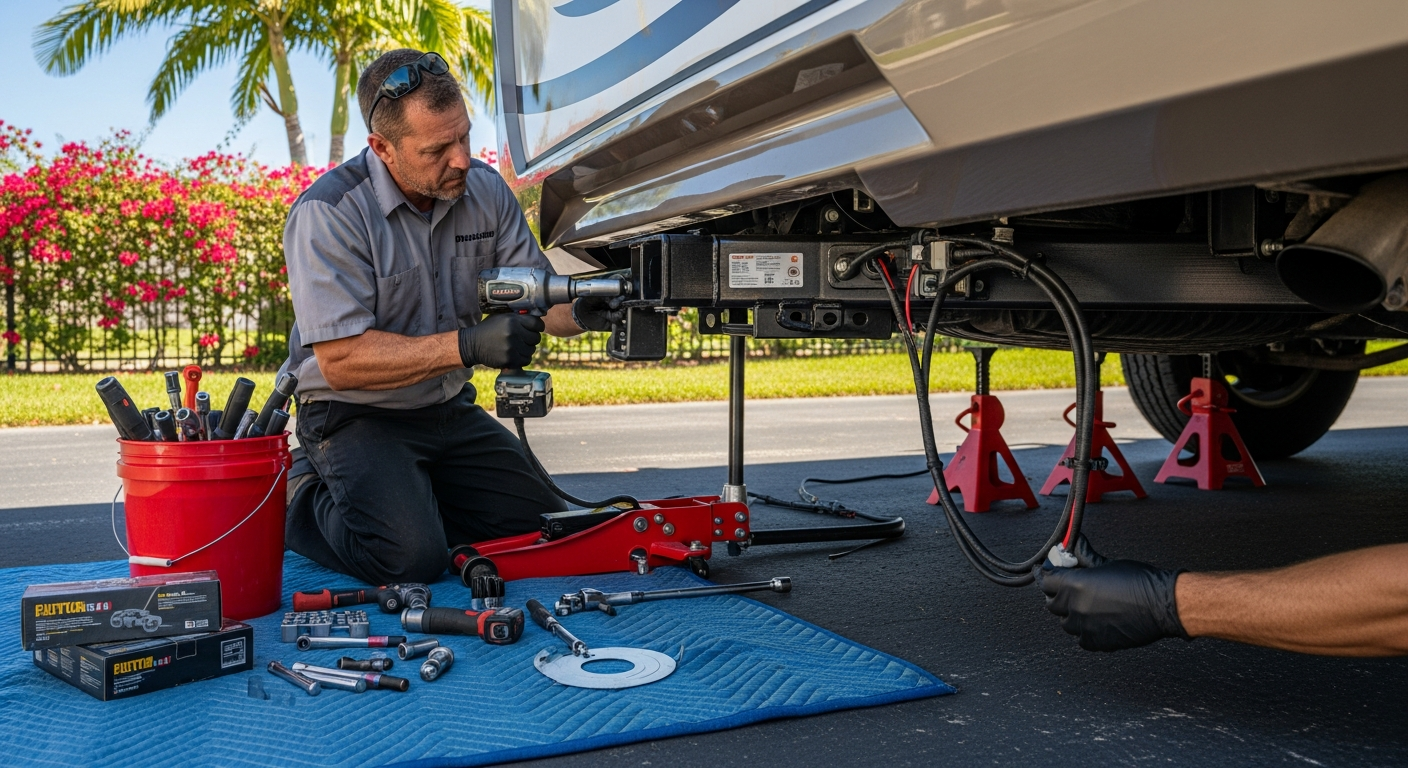
For RV Towing "Without A Hitch", Make Sure The Actual Hitch Is Installed Professionally
Professional hitch installation eliminates the guesswork and liability issues associated with DIY installations. Certified technicians understand vehicle-specific requirements, electrical integration, and weight distribution setup that provides safe, legal towing operations.
Improper hitch installation causes problems ranging from poor handling to complete hitch failure. Professional installers verify tow vehicle capacity, select appropriate hardware, and apply proper torque specifications on all connections. They also integrate brake controllers and electrical systems according to manufacturer specifications.
Professional installation includes weight distribution setup and adjustment, providing proper tongue weight and level towing attitude. This service eliminates the trial-and-error process of DIY setup while providing warranty coverage on parts and labor. The investment in professional installation pays dividends in safety, performance, and peace of mind throughout years of towing adventures.
R&B HITCH OF OCALA
City: Fort McCoy
Address: 10670 Northeast 227th Place Road
Website: https://rbhitchofocala.com/small-welding-jobs-welding-repairs


Comments
Post a Comment